Choosing the right molded case circuit breaker (MCCB) is an important decision when designing or upgrading an electrical distribution system. The breaker must match the system’s current requirement, fault level, protection strategy, installation environment, panel configuration and future expansion plans.
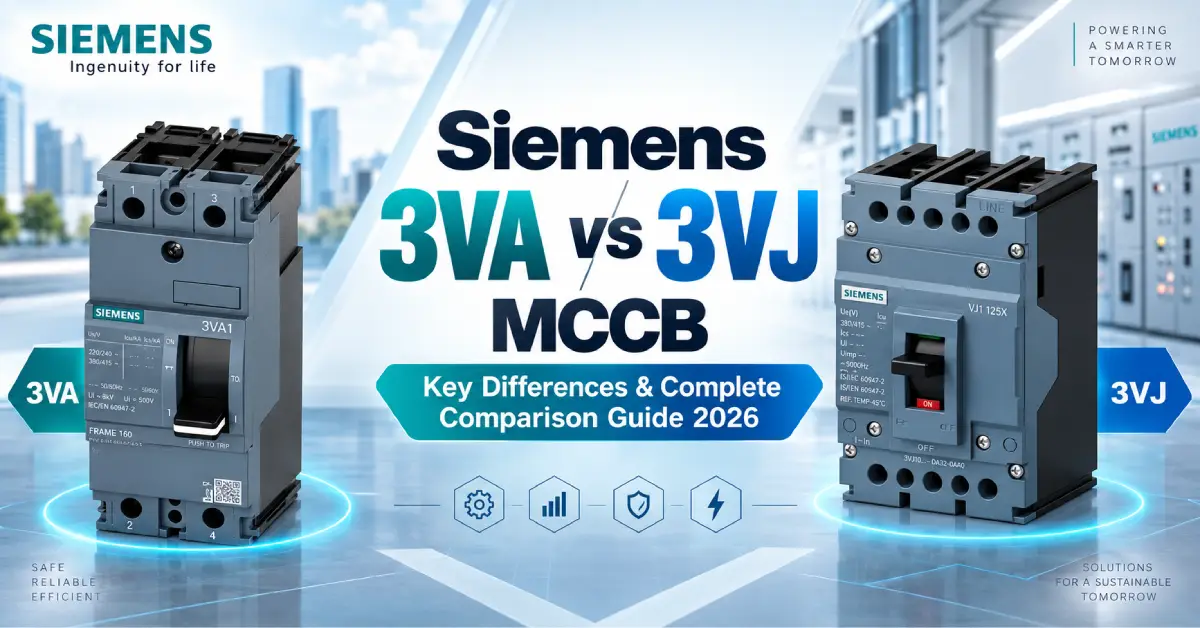
Among Siemens MCCB options, the 3VA and 3VJ ranges are two products that buyers, contractors, panel builders and electrical professionals may consider for different applications. Although both are designed for low-voltage circuit protection, they differ in their range, trip-unit technology, breaking capacities, accessory options, applications and level of system integration.
The Siemens SENTRON 3VA family is designed as a highly modular MCCB platform for power distribution, motor and machine protection, with thermal-magnetic and electronic trip-unit options depending on the model. Siemens lists 3VA variants with rated currents extending up to 1,250 A and breaking capacities that can reach 55kA to 110kA150 kA
The Siemens SINOVA 3VJ range is a compact MCCB family focused primarily on thermal-magnetic protection. The current Siemens catalogue lists 3VJ frames from 125 A-class frames through 630 A, with breaking capacities up to 55 kA to 1000 applicable versions.
What Is a Siemens MCCB?
A Molded Case Circuit Breaker (MCCB) is a low-voltage protection device used to protect electrical circuits against conditions such as overloads and short circuits.
Unlike an MCB, MCCB are generally used for higher current applications and provide greater flexibility in terms of current ratings, breaking capacity, trip settings and accessories.
An MCCB can be used as an incoming or outgoing protection device in distribution boards, control panels, industrial machines and other electrical installations.
The basic protection functions include:
|
Overload protection – protects conductors and equipment when current remains above the permissible level for a sustained period.
|
|
Short-circuit protection – disconnects the circuit rapidly when a high fault current occurs.
|
|
Isolation – allows a circuit or equipment section to be safely isolated where the selected MCCB is suitable for isolation.
|
|
Additional protection functions – depending on the MCCB model and trip unit, additional functions such as selective protection, ground-fault protection, measurement and communication may be available.
|
Siemens offers several MCCB families, including the SENTRON 3VA and SINOVA 3VJ ranges. The two families therefore need to be evaluated according to their intended application rather than treating them as identical alternatives.
What Is Siemens 3VA MCCB?
The Siemens SENTRON 3VA is a modular MCCB platform designed for power distribution as well as applications involving motors, machines and other electrical equipment.
The 3VA family covers multiple frame sizes and configurations. Siemens currently lists 3VA1, 3VA2, frame variants.
One of the main strengths of the 3VA platform is flexibility.
Depending on the selected model, users can choose between thermal-magnetic and electronic trip units. Electronic versions can provide more advanced protection and measurement functions, while communication modules can allow integration with higher-level automation and energy-management systems.
Key characteristics of Siemens 3VA
Broad current range
• Multiple frame sizes
• Thermal-magnetic and electronic trip-unit options
• High breaking-capacity options
• Selective protection possibilities
• Measurement capabilities on applicable electronic versions
• Communication and automation integration
• Extensive accessory ecosystem
• Suitable for demanding distribution applications
• Options for motor, generator, and machine protection
For projects where protection coordination, monitoring, communication or future expansion is important, these capabilities can make the 3VA platform particularly attractive.
What Is Siemens 3VJ MCCB?
The Siemens SINOVA 3VJ is an MCCB range designed primarily around practical and compact thermal-magnetic protection requirements.
According to Siemens’ current SINOVA documentation, covering rated current ranges from 16 A through 630 A depending on the frame and configuration.
The main 3VJ range uses thermal-magnetic trip technology, including fixed thermal-fixed magnetic (FTFM). The catalogue also lists 1, 2, 3 and 4-pole configurations depending on the frame.
Breaking capacity varies according to the selected frame and model. Siemens lists options ranging up to 10 KA at 25kA for applicable 3VJ variants.
Key characteristics of Siemens 3VJ
• Compact MCCB design
• Rated current options up to 630 A
• Thermal-magnetic trip technology
• Fixed and adjustable thermal options depending on model
• 1,2, 3, and 4-pole options across the range
• Breaking capacities up to 10kA to 25kA for applicable versions
• Suitable for standard power-distribution protection
• Accessories including auxiliary, alarm, shunt-trip and undervoltage options on applicable models
• Screw-terminal connection technology
For projects that primarily need dependable thermal-magnetic circuit protection without the advanced monitoring and communication requirements of higher-end MCCB platforms, 3VJ can be a practical choice.
Why Does the 3VA vs 3VJ Comparison Matter?
At first glance, both products are Siemens MCCB, so it may seem that selecting one is simply a matter of choosing the required ampere rating.
That approach can lead to incorrect product selection.
A panel builder may need a breaker with electronic protection and communication capability. An electrical contractor may need a compact thermal-magnetic MCCB for a conventional distribution board. An OEM may require repeatable breaker configurations across multiple machines. A public-sector project may have specific technical specifications, approved makes, fault-level requirements and documentation requirements.
These situations can lead to very different MCCB requirements.
The comparison therefore matters because the right MCCB is determined by the complete electrical requirement not just the current rating.
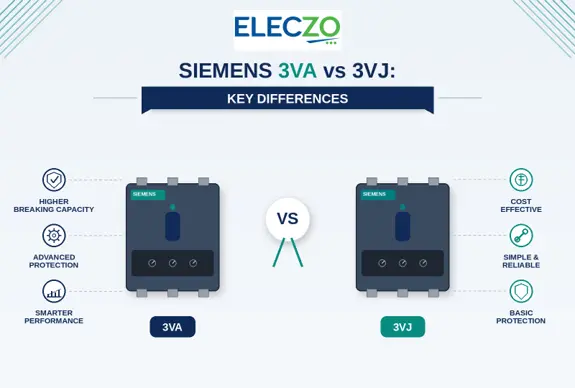
Siemens 3VA vs 3VJ: Key Differences
|
Parameter |
Siemens 3VA |
Siemens 3VJ |
|
Product family |
SENTRON |
SINOVA |
|
Main positioning |
Modular, |
Compact, |
|
Current range |
Up |
Up |
|
Trip technology |
Thermal-magnetic |
Primarily |
|
Electronic trip units |
Available |
Not |
|
Breaking capacity |
55kA |
Up |
|
Measurement |
Available |
Limited |
|
Communication |
Available |
Not |
|
Accessories |
Very |
Standard |
|
Selective protection |
Advanced |
More |
|
Typical use |
Advanced |
Standard |
|
Project complexity |
Medium |
Basic |
|
No.Of Poles |
2 |
1 |
The exact specifications always depend on the individual article number, frame, trip unit, breaking-capacity class and configuration. Siemens’ product catalogue should therefore be checked before final selection.
Accessories and Panel Integration
Accessories can become an important consideration for panel builders and OEMs.
The 3VA platform is designed around a highly modular accessory concept. Siemens states that more than 522 accessories are available across the platform, including auxiliary switches, shunt trips, undervoltage releases, communication modules, mounting kits and test devices.
This is particularly useful when a panel needs:
• Remote tripping
• Breaker status feedback
• Undervoltage release
• Communication
• Energy monitoring
• Interlocking
• Automated control
The 3VJ range also supports practical accessories such as auxiliary switches, alarm switches, shunt trips and undervoltage releases on applicable frames. Siemens’ 3VJ documentation also lists external accessories such as door-mounted rotary handles and spreader terminals.
The key difference is that 3VA provides a much broader platform for advanced integration, while 3VJ focuses more on the essential functions required in conventional MCCB applications.
Applications of Siemens 3VA MCCB
The 3VA range can be considered when the project requires higher levels of flexibility, protection coordination or system integration.
Typical applications include:
• Main distribution panels
• Industrial distribution systems
• Commercial infrastructure
• Manufacturing plants
• Machine protection
• Motor-related applications
• Generator protection
• Data and energy-intensive facilities
• Infrastructure projects
• Advanced automation environments
• Panels requiring monitoring and communication
Siemens specifically describes 3VA MCCB for protection of power distribution systems, motors and machines, with integration into automation and energy-management systems available on applicable configurations.
Applications of Siemens 3VJ MCCB
3VJ can be considered where the primary requirement is dependable thermal-magnetic circuit protection within its rated range.
Typical applications can include:
• Distribution boards
• Building electrical panels
• Commercial installations
• Industrial auxiliary distribution
• Small and medium power-distribution systems
• General-purpose feeder protection
• OEM panels with standard protection requirements
The suitability depends on the project’s fault level, load current, voltage, coordination requirements and applicable specifications.
3VA vs 3VJ for Electrical Contractors
For electrical contractors, installation practicality and project specifications are usually important.
|
Choose 3VJ when:
|
Consider 3VA when:
|
|
· The required current is within its range. · Thermal-magnetic protection is sufficient. · Advanced communication is not required. · The panel has conventional protection requirements. · The specified fault level is compatible with the selected model.
|
· The project requires higher current ratings. · Selective coordination is important. · Electronic trip protection is required. · Monitoring or communication is required. · Future expansion is expected. · The panel forms part of a more sophisticated power-management system.
|
3VA vs 3VJ for Panel Builders
• Panel builders should look beyond the breaker rating and evaluate the complete panel architecture.
• For a standard distribution panel, 3VJ may provide the required protection without unnecessary complexity.
• For an advanced panel, 3VA can offer greater flexibility through electronic trip units, accessories, measurement and communication options.
• This can become particularly valuable when the same panel design must be adapted for different projects.
3VA vs 3VJ for OEMs
OEMs often value repeatability, availability of accessories, panel footprint and integration with machine controls.
A 3VJ solution can make sense when the OEM machine requires conventional MCCB protection.
A 3VA solution can be more appropriate when the machine or system requires:
• Advanced protection
• Remote status
• Communication
• Measurement
• Adjustable trip parameters
• Integration with automation systems
The choice should be based on the machine’s electrical architecture rather than simply selecting the higher-specification breaker
3VA vs 3VJ for Dealers and Distributors
Dealers should understand the customer’s application before recommending a Siemens MCCB.
it is better to confirm:
• Number of poles
• System voltage
• Short-circuit level
• Icu/Ics requirement
• Trip-unit type
• Adjustable protection requirement
• Auxiliary accessories
• Shunt trip requirement
• Undervoltage release requirement
• Communication requirement
• Installation type
• Project standards
• Required current
3VA vs 3VJ for End Users and Public-Sector Projects
For end users and public-sector procurement teams, compliance with the project specification is especially important.
A technically suitable MCCB should be evaluated against:
• Required IEC standards
• Rated voltage
• Rated current
• Short-circuit capacity
• Trip characteristics
• Number of poles
• Accessories
• Panel compatibility
• Documentation
• Testing and certification requirements
• Long-term maintenance requirements
• Approved manufacturer requirements
How to Select Between Siemens 3VA and 3VJ
Use the following decision process.
1: Determine the load current
Calculate the expected continuous operating current and select the appropriate MCCB rating.
2: Determine the fault level
Establish the prospective short-circuit current at the installation point.
3: Select the required breaking capacity
Make sure the selected MCCB’s Icu is appropriate for the calculated fault level.
4: Decide on trip technology
Ask whether thermal-magnetic protection is sufficient or whether electronic protection is required.
5: Check coordination requirements
If selective coordination is important, evaluate the available trip-unit and protection options carefully.
6: Check accessories
Identify whether the panel requires:
· Auxiliary contacts
· Alarm contacts
· Shunt trip
· Undervoltage release
· Rotary handle
· Interlocking
· Communication
· Measurement
7: Check panel dimensions and connections
Confirm that the selected MCCB fits the panel design and that the required connection method is compatible.
8: Consider future requirements
If the system may later require monitoring, automation or higher capacity, a more modular platform may provide greater flexibility.
Common Selection Mistakes to Avoid
1. Choosing only by ampere rating
A 250 A breaker is not automatically suitable for every 250 A application.
Check voltage, fault level, trip settings and installation conditions.
2. Ignoring Icu
The MCCB must have adequate short-circuit breaking capacity for the installation.
3. Assuming all Siemens MCCBs have identical features
Different Siemens families and models have different trip technologies, accessories and capabilities.
4. Selecting advanced features without a requirement
Not every panel needs communication or electronic measurement. Avoid unnecessary complexity when the application does not require it.
5. Ignoring future expansion
For projects expected to become more automated or monitored, consider whether the MCCB platform can support future requirements.
6. Not checking the exact article number
A product family name alone is not enough. Specifications can vary significantly between individual MLFB/article numbers.
Final Thoughts
Choosing between Siemens 3VA and 3VJ MCCBs depends on the specific requirements of the electrical system rather than simply the current rating. The 3VJ range is a practical choice for applications that require reliable thermal-magnetic protection within its available ratings, while the 3VA range offers greater flexibility for projects that require advanced protection, higher capacity, monitoring, communication or a wider range of accessories.
At Eleczo, buyers can compare Siemens MCCB options based on important parameters such as current rating, breaking capacity, trip-unit type, number of poles and required accessories. Whether you are an electrical contractor, panel builder, OEM, dealer, end user or part of a public-sector project, reviewing these specifications against your application can help you select a suitable Siemens MCCB with greater confidence.