Delta VFDs and conventional motor starters are essential components in industrial motor control systems, but modern plants increasingly require smarter and more energy-efficient solutions. Traditional motor starters are designed for basic on-off operation, whereas Delta Variable Frequency Drives (VFDs) provide precise speed control, smoother motor performance, and enhanced equipment protection.
As industries move toward automation, energy optimization, and sustainable operations, selecting the right motor control technology becomes a strategic decision. This article compares Delta VFDs and conventional motor starters to help plant managers and engineers understand their differences, performance advantages, and long-term value in modern industrial environments.
Why Motor Control Technology Matters in Modern Plants
Motor control technology plays a critical role in ensuring efficiency, reliability, and safety in modern industrial plants. In sectors such as manufacturing, HVAC, and water treatment, advanced motor control systems regulate speed, reduce energy waste, and protect equipment from electrical and mechanical stress. As industries adopt automation and high-performance production systems, effective motor control becomes essential for maintaining stable operations and minimizing costly downtime.
Key reasons motor control technology is important include:
- Improved energy efficiency and reduced operating costs
- Greater process stability and production consistency
- Lower maintenance through reduced mechanical stress
- Enhanced safety and motor protection features
- Seamless integration with automated control systems
By implementing advanced motor control solutions, plants can improve productivity while extending equipment lifespan. For engineers and facility managers, modern motor control technology is a key investment for sustainable and competitive industrial operations.
Understanding Conventional Motor Starters and Delta VFD
Conventional Motor Starters
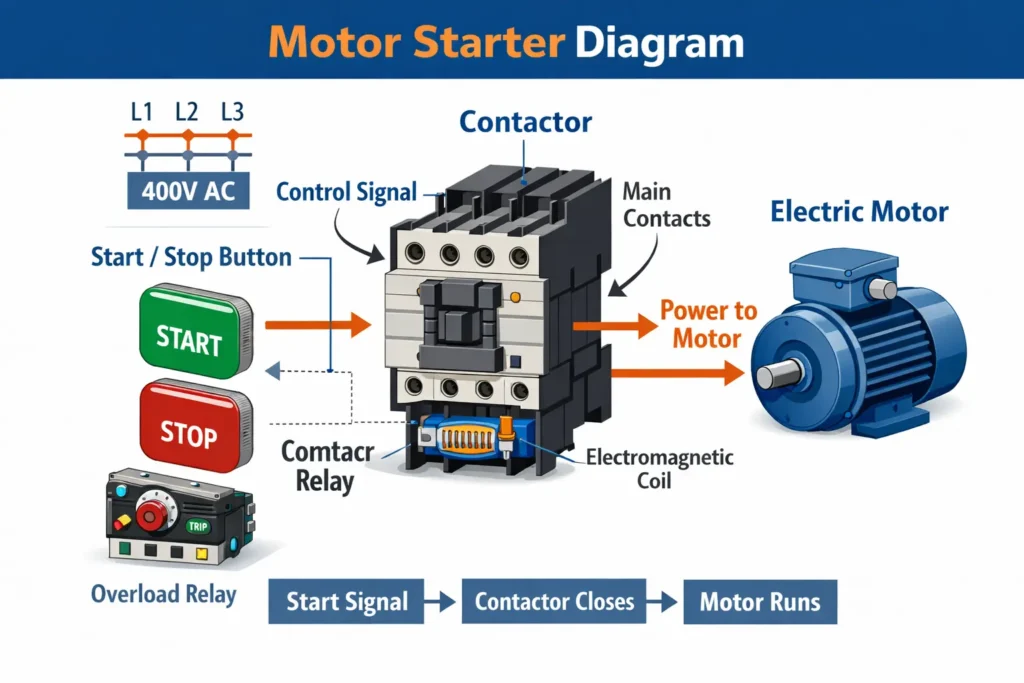
Conventional motor starters are commonly used in industrial plants to provide safe motor starting, stopping, and overload protection. They are best suited for fixed-speed applications such as basic conveyors and constant-load machinery. Because these starters operate motors at full speed, they are simple and cost-effective but offer limited control over energy consumption. In high-duty industrial environments, fixed-speed operation can increase mechanical stress and operating costs, which is why their use is typically limited to straightforward applications.
Key characteristics of conventional motor starters include:
- Reliable start-stop control for fixed-speed motors
- Built-in overload and electrical protection
- Simple design with low installation complexity
- Suitable for basic industrial machinery
Delta VFD
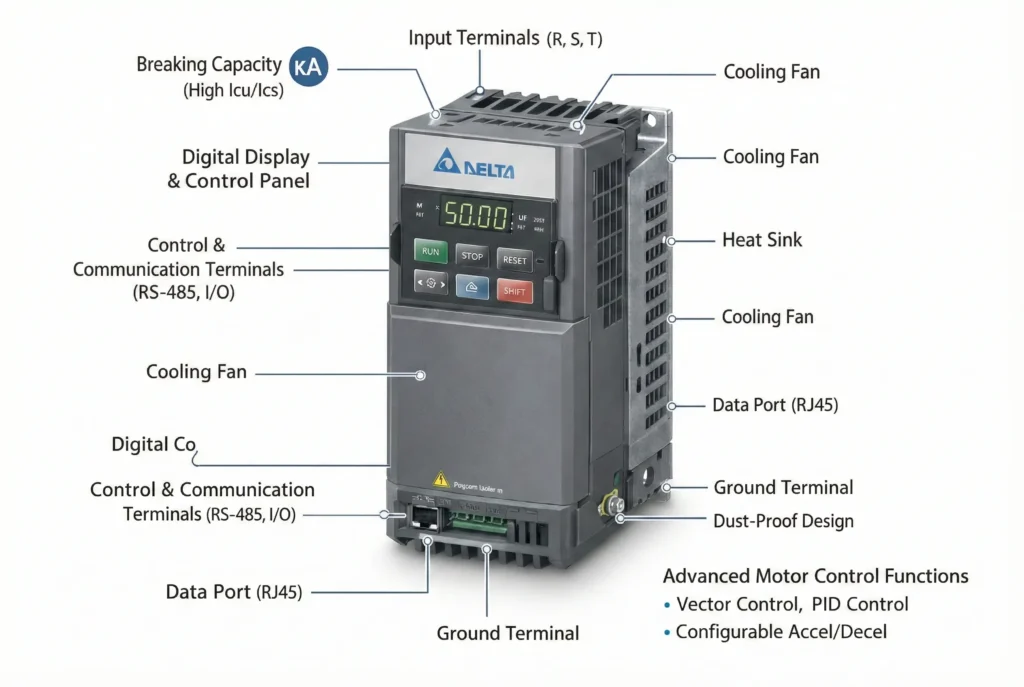
Delta Variable Frequency Drives (VFDs) provide advanced motor control by adjusting voltage and frequency to match real-time process demands. This makes them ideal for variable-load applications such as pumps, fans, and automated production lines. By enabling precise speed regulation, Delta VFDs improve energy efficiency, reduce equipment wear, and enhance process stability. Their compatibility with modern automation systems allows seamless integration into smart industrial operations.
Key characteristics of Delta VFDs include:
- Precise variable speed and torque control
- Significant energy optimization potential
- Reduced mechanical stress and smoother operation
- Integration with industrial automation platforms
How Delta VFD Technology Differs from Traditional Starting Methods
Delta VFD technology differs from traditional motor starters in how it controls speed, energy use, and system performance. Conventional starters run motors at full speed instantly, often causing high inrush current and mechanical stress. Delta VFDs gradually adjust voltage and frequency to provide smooth speed control, reducing electrical strain and improving efficiency. In modern industrial environments focused on automation and energy optimization, VFD-based control offers a more flexible and reliable alternative to traditional starting methods.
Key Differences:
| Feature | Delta VFD Technology | Traditional Starting Methods |
| Start/Stop Behavior | Soft start and smooth stop control | Direct full-speed startup |
| Speed Control | Variable speed and torque control | Fixed-speed operation only |
| Electrical Impact | Lower inrush current and reduced electrical stress | High inrush current during startup |
| Energy Performance | Improved energy efficiency and process optimization | Higher energy consumption |
| Automation Compatibility | Easily integrates with automated control systems | Limited automation compatibility |
Energy Efficiency Comparison: Delta VFD vs Motor Starter
Energy efficiency is a critical factor in modern industrial operations, where rising power costs and sustainability goals directly impact profitability. Motor control technology plays a major role in determining how efficiently electrical energy is converted into mechanical output. While conventional motor starters operate motors at constant full speed, Delta VFDs adjust motor speed according to real-time load demand. This intelligent control reduces unnecessary energy consumption and improves overall system efficiency, especially in variable-load applications such as pumps and fans.
Energy Efficiency Overview
| Parameter | Delta VFD | Conventional Motor Starter |
| Motor Speed Operation | Adjustable based on load demand | Runs at constant full speed |
| Energy Consumption | Optimized according to process needs | Higher energy usage in variable loads |
| Power Loss | Reduced through controlled operation | Increased due to fixed-speed running |
| Efficiency in Variable Loads | High efficiency | Low efficiency |
| Long-Term Energy Savings | Significant potential savings | Limited savings |
By enabling demand-based motor operation, Delta VFDs help plants achieve measurable energy savings and improved operational efficiency. For industries focused on reducing operating costs and enhancing sustainability, VFD-based motor control offers a clear advantage over traditional starter systems.
Performance and Speed Control: Delta VFD vs Motor Starter
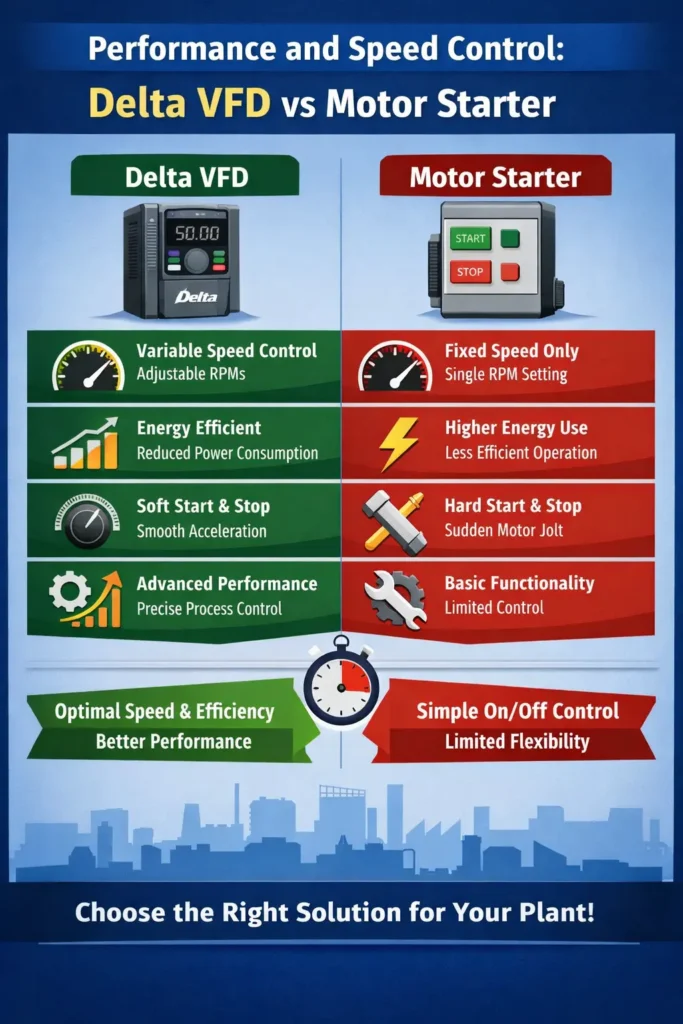
Motor performance and speed control directly influence productivity and equipment reliability in industrial environments. Delta VFDs and conventional motor starters differ significantly in how they manage speed, torque, and operational smoothness. A feature-by-feature comparison highlights how each technology performs under real industrial conditions.
Speed Control Capability
Delta VFDs allow precise variable speed regulation by adjusting motor frequency in real time, making them suitable for applications requiring flexible output. Conventional motor starters operate motors at fixed speed, limiting adaptability in variable-load processes
Acceleration and Startup Behavior
Delta VFDs provide smooth ramp-up and ramp-down control, reducing electrical and mechanical stress. Motor starters typically start motors instantly at full speed, which can increase wear on mechanical components.
Torque and Load Management
Delta VFDs dynamically adjust torque to match changing load conditions, improving process stability. Motor starters offer minimal torque control and are better suited for constant-load applications.
“Overall, Delta VFDs deliver superior performance, flexibility, and operational control compared to conventional motor starters. For modern industrial systems requiring efficiency and precision, VFD technology offers a clear performance advantage.”
Cost and ROI: Delta VFD vs Motor Starter
Cost and return on investment are important factors when choosing motor control technology. Conventional motor starters have lower upfront costs and suit simple fixed-speed applications. Delta VFDs, however, provide long-term savings through improved energy efficiency and reduced equipment wear. In many variable-load industrial applications, VFDs can reduce energy consumption by 20–40%, helping offset the higher initial investment. Evaluating total lifecycle cost helps organizations make smarter, more sustainable decisions.
Cost and ROI aspects of Delta VFDs:
- Higher upfront investment compared to basic starters
- Reduced long-term energy consumption
- Lower maintenance due to smoother motor operation
- Strong potential for lifecycle cost savings
Cost and ROI aspects of conventional motor starters:
- Lower initial purchase and installation cost
- Higher operating energy consumption in variable loads
- Increased maintenance from mechanical stress
- Limited long-term ROI in efficiency-driven applications
A balanced cost and ROI assessment helps industries match technology with operational goals. The best choice depends on process demands, energy priorities, and the desired level of performance control.
Recommended Delta VFD Products for Modern Plants
Below are highly regarded Delta Variable Frequency Drives (VFDs) that are suitable for diverse industrial applications, helping modern plants achieve improved energy efficiency, smoother motor control, and enhanced operational reliability. These options cater to both general and specialized requirements — from standard manufacturing lines to complex automated systems.
Top Delta VFD solutions include:
- Delta C2000 Series VFDs – Compact and versatile drives ideal for general-purpose industrial applications with energy-saving features.
- Delta VFD-EL Series – Designed for pumps, fans, and HVAC systems with built-in control functions for improved process regulation.
- Delta VFD-ME Series – High-performance drives suited for demanding motor control, precision speed regulation, and heavy-duty environments.
- Delta VFD-E Series – Cost-effective option for basic motor speed control and simple automation tasks.
Choosing the right model depends on load type, operational requirements, and integration needs. For variable torque and energy-sensitive applications, mid-to-high range VFDs provide the best performance and ROI.
Industrial Applications of Delta VFDs vs Motor Starters
Industrial applications require motor control solutions that match specific operational demands, load characteristics, and efficiency goals. Delta VFDs are commonly used in environments that need variable speed control, energy optimization, and precise automation. Conventional motor starters, on the other hand, are better suited for simple fixed-speed machinery where advanced control is not required. Understanding how each technology fits different industrial use cases helps plant engineers and decision-makers select the most practical and cost-effective motor control strategy.
| Industrial Application | Delta VFD Usage | Motor Starter Usage |
| Pumps and Fans | Variable flow control and energy savings | Constant-speed pumping or ventilation |
| Conveyor Systems | Adjustable speed and smooth operation | Basic start-stop movement |
| HVAC Systems | Energy-efficient climate control | Fixed-speed airflow systems |
| Manufacturing Automation | Precise process and speed control | Limited suitability |
| Simple Machinery | Advanced control when required | Cost-effective fixed-speed operation |
Where to Buy Genuine Delta VFDs for Your Modern Plants?
Selecting a reliable supplier is as important as choosing the right motor control technology. Eleczo provides genuine Delta VFD solutions designed to meet the performance and reliability needs of modern industrial plants. By sourcing from an authorized and experienced distributor, businesses can ensure product authenticity, technical support, and consistent availability. Eleczo focuses on delivering quality components that support efficient installation, long-term operation, and seamless integration with industrial systems.
Why industries choose Eleczo for Delta VFDs:
- Genuine Delta products with assured quality
- Competitive pricing for industrial buyers
- Reliable availability and fast delivery
- Professional customer and technical support
- Solutions tailored to plant requirements
Partnering with a trusted supplier like Eleczo ensures smooth and dependable industrial operations by providing genuine Delta VFDs, reliable support, and consistent product availability for long-term performance.
Final Verdict
Choosing between Delta VFDs and conventional motor starters comes down to what your plant actually needs. If your operations demand energy efficiency, automation, and precise speed control, Delta VFDs offer a clear advantage by improving performance and reducing long-term operating costs. For simple applications that run at a constant speed, conventional motor starters can still be a practical and cost-effective choice.
The best decision comes from evaluating real operational requirements, not just upfront cost. By considering application type, lifecycle expenses, and performance expectations, plant managers and engineers can select a motor control solution that supports reliable, efficient, and future-ready industrial operations.